A Calm Guide to Choosing Songs That Feel Like You (Not a Performance)
Ceremony music isn’t there to fill space. It’s there to shape a feeling—so the room softens, your shoulders drop, and the moment becomes real.
If you’ve ever worried that music might feel like “a show,” or that it could push emotion instead of letting it arrive naturally, this guide is for you. The most elegant ceremonies aren’t built on more songs. They’re built on the right structure, intentional timing, and a musician who knows how to support the moment without taking it over.
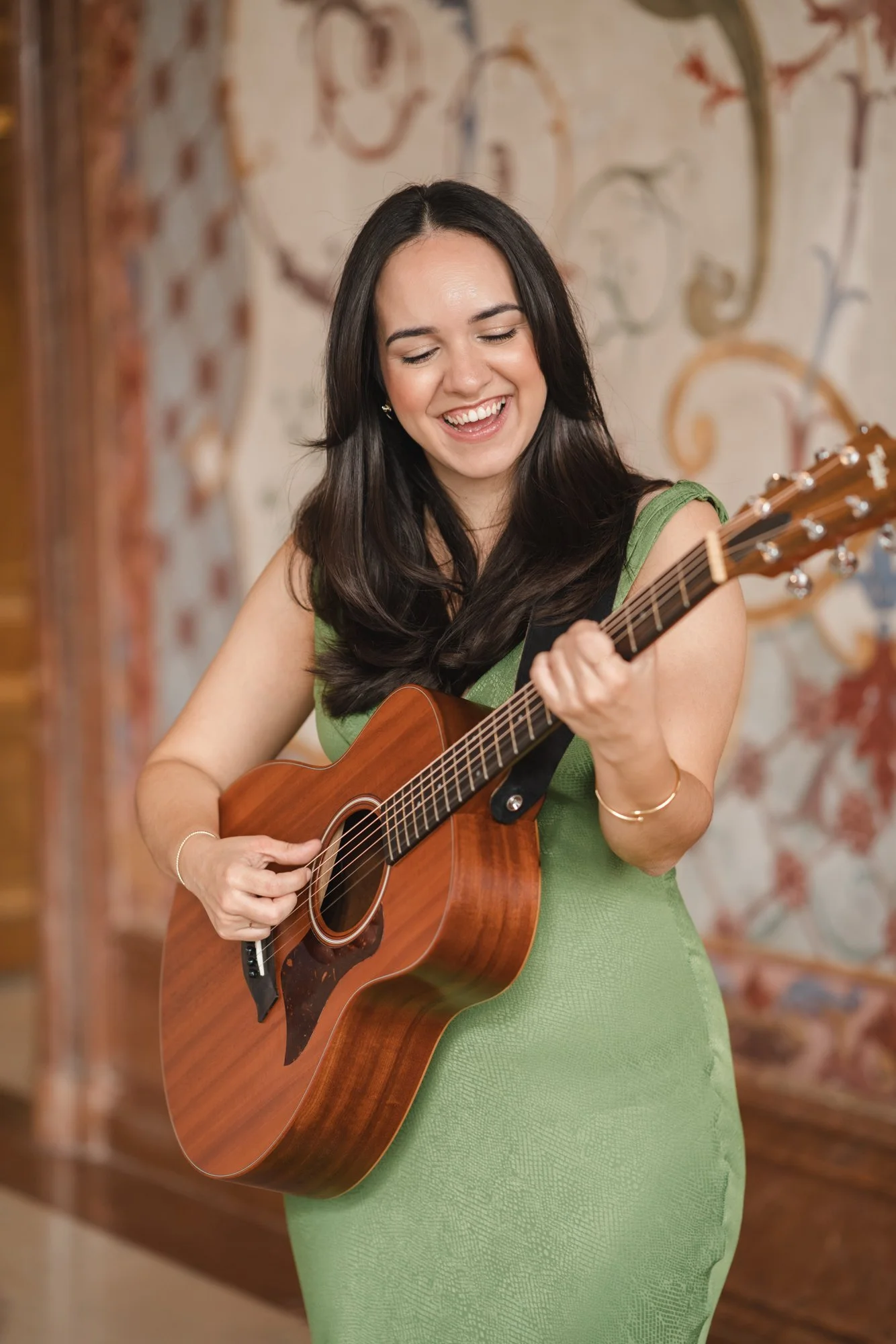
I’m Deborah — a singer who approaches weddings like a craft: atmosphere, pacing, and emotional detail. Here’s the framework I use with couples and planners to create ceremony music that feels clean, intimate, and deeply personal.
If you want the bigger picture first (ceremony → aperitif → dinner → first dance), start here: Choosing your wedding music: where do you even begin?
1. The Structure That Keeps Everything Calm: 3 Anchor Songs + One “Arrive” Song
Most ceremonies need three fixed songs, plus one optional moment that makes everything feel more spacious.
Song #1: The Processional (Entrance)
This is the tone-setter. Not just “walking music,” but the first emotional statement of the day. It should feel steady, warm, and confident—never rushed.
Optional: The “Arrive” Song (between welcome + vows)
This is my favourite extra moment.
It’s often the only place in the ceremony where you don’t have to do anything: you’re not walking, kissing, signing, or holding an object. You’re simply standing there, breathing, and letting it land.
One song here can change the entire ceremony. It gives you time to arrive in your body and in the moment—quiet luxury, in the truest sense.
Song #2: The Emotional Core (built live around vows + rings + kiss)
This part works best when music is treated as a living thing rather than a fixed track.
Here’s how I often shape it musically:
Vows: gentle guitar underscore only (romantic, intimate, never distracting)
Rings: the music stays supportive and flexible
Kiss: this is where vocals enter — so the voice arrives exactly when emotion peaks
Signing (if included): we can stretch the song seamlessly so timing stays effortless
Song #3: The Recessional (Exit)
This is the release. Joy, lightness, movement—without turning the ceremony into a concert. A great recessional lifts the room and carries you out.
A simple truth: fewer songs, placed well, feel more intentional than a long list.
2. How to Choose Songs That Feel Like You (Without “Cheese”)
If you’re unsure what fits, ask these five questions:
Intimate or cinematic?
Do you want something close and minimal—or something with a gentle swell?What’s your emotional temperature?
Tender? Bright? Soulful? Quietly joyful?What’s your aesthetic: clean, warm, vintage, modern?
This matters more than genre. A soul song can feel elegant; a pop song can feel timeless—if the interpretation matches your space.Which languages belong to you?
Multilingual music can be profoundly personal when it’s structured with intention.Do you want music that leads, or music that supports?
There’s no “right” answer—only alignment.
A quick note on “cheesy”:
A song rarely feels cheesy on its own. It becomes cheesy when the arrangement is too heavy, the volume is too high, or the emotion is pushed. A refined live interpretation—right key, right tempo, right timing—can make even a well-known song feel completely elevated.
3. Curated Ceremony Song Ideas (By Mood + Moment)
This is intentionally not a massive list. These are songs that translate beautifully live and feel elegant across many styles of weddings.
Processional (Entrance)
“Fields of Gold” – Sting / Eva Cassidy (timeless, warm, understated elegance)
“Turning Page” – Sleeping At Last (soft cinematic, emotionally clear)
“Can’t Help Falling in Love” – Elvis Presley (simple, iconic, gentle)
“Make You Feel My Love” – Adele / Bob Dylan (steady emotion, grounded)
Optional “Arrive” Song (after the welcome)
“You To Me Are Everything” – The Real Thing (classic soul, celebratory, feel-good)
“Best Part” – Daniel Caesar ft. H.E.R. (soul, understated)
“La Vie En Rose” – Édith Piaf (romantic, classic, softly cinematic)
“Come Away With Me” – Norah Jones (quiet, warm, effortless)
Emotional Core (kiss -> signing)
These work beautifully when vocals enter on the kiss and can continue into signing:
“this is how you fall in love” – Jeremy Zucker ft. Chelsea Cutler (gentle build, emotional clarity)
“I Love You Always Forever” – Donna Lewis (nostalgic, bright, sweetly emotional)
“Lover” – Taylor Swift (modern romantic, intimate, gently upbeat)
Instrumental option: voice + violin can be stunning here—clean lines, no rush.
Recessional (Exit)
“Ain’t No Mountain High Enough” – Marvin Gaye & Tammi Terrell (joyful, iconic, high-energy exit)
“You’ve Got the Love” – Florence + The Machine (uplifting, modern, joy-forward)
“This Will Be (An Everlasting Love)” – Natalie Cole (bright, classy, unforgettable)
“Signed, Sealed, Delivered” – Stevie Wonder (soulful, joyful, confident)
“Stand by Me” – Ben E. King (warm, communal, timeless)
4. Multilingual Ceremony Music (Without Feeling Fragmented)
Multilingual ceremonies can be incredibly moving—when they feel cohesive.
Two approaches that work beautifully:
Option A: One language per moment
Entrance in one language
“Arrive” song in another
Emotional core in the couple’s most intimate language
Exit in the language that feels most shared with guests
Option B: One main language + one “private” language
Keep most music in one language, and choose one song that belongs only to you as a couple.
The key: avoid constant switching. Let each moment have its own identity.
For a real-life example of a bilingual wedding (and how music supports both families), see: Austrian–Italian wedding on Schlossberg Graz | Birgit & Roberto
5. Planner-Friendly: Cues, Alignment, and Why Live Timing Matters
A calm ceremony is usually a well-timed one.
After our Final Planning Session, you’ll receive a detailed written recap of every cue, transition, and timing—so you, your planner, and everyone involved (officiant/celebrant/registrar) knows exactly what happens when. It removes pressure in the moment and keeps the ceremony seamless.
Here’s the cue logic I love because it’s simple:
Start Song #1 when the processional begins
Optional “Arrive” song after the welcome, before vows
Guitar underscore begins softly under vows
Vocals enter on the kiss; continue into signing if needed
Start Song #3 on the exit cue
This is exactly where live music shines — here’s a destination wedding where timing shifted, and we kept the flow effortless: Castello di Buttrio | Antonia & Tom
Live vs playlist (the honest version)
A playlist can work. Live music tends to feel different because it can:
follow the room’s breathing and pauses
stretch or shorten naturally (no awkward fades)
support emotion without pushing it
This is especially valuable in the emotional core of the ceremony.
6. Choosing the Right Musician Matters More Than the Perfect Song
Everyone brings a different energy. Some musicians naturally treat the ceremony as a spotlight moment. Others approach it with quiet confidence—present, supportive, and intentionally understated.
If you want elegance without performance, look for someone who:
listens carefully and adapts live
cares about timing and transitions as much as vocals
feels comfortable being part of the architecture of the day, not the centre of it
That single choice will shape how “calm” the ceremony feels.
If you’re drawn to an elegant second layer of sound, here’s why voice + guitar + violin can feel so cinematic and still intimate: The special touch: voice, guitar & violin
7. A Quick Checklist You Can Send to Your Planner (or Musician)
Copy/paste this:
Date + venue + ceremony start time
Indoor/outdoor + weather plan B
Languages involved (EN/DE/ES/…)
Your structure: 3 anchor songs + optional “arrive” song
Song placement: entrance / arrive / kiss+signing / exit
Who gives the start cue (planner/officiant)
Microphones needed (officiant + vows)
Any “must-have” or “please avoid” songs
Will you need cocktail hour / dinner music after?
FAQ
How many songs do we need for a wedding ceremony?
Usually 3–5 songs: entrance, one quiet moment (rings/ritual/signing), exit—plus optional prelude music.
What if we don’t want the ceremony to feel like a “performance”?
Choose simpler arrangements, keep volume natural, and place songs only where they support the moment. Less is more.
Also: choose the right musician. Everyone brings a different energy. Some artists naturally treat the ceremony as a “spotlight moment.” Others see themselves as part of the architecture of the day—present, supportive, and intentionally understated. When you want calm elegance, look for someone who listens, adapts live, and cares as much about timing and transitions as about the song itself.
Can we mix English and German (or Spanish) in the ceremony music?
Yes—multilingual works best when each moment has a clear language identity, rather than switching every song.
When should we book a wedding singer for a (destination) wedding in Austria?
As soon as you have your date + venue, especially for peak season weekends. Availability is the main factor.
Conclusion:
In the end, ceremony music isn’t about filling space. It’s about shaping a moment that feels honest—one that lets you breathe, arrive, and be fully present.
A simple structure (three anchor songs, plus one optional “arrive” song) creates calm. And when the music is built live around your vows—guitar softly supporting, vocals entering right on the kiss—everything lands naturally, without rushing or forcing emotion.
After our Final Planning Session, you’ll receive a detailed written recap of every cue and transition, so you, your planner, and your officiant/celebrant/registrar are fully aligned. And one last thought: choosing the right musician matters. Everyone brings a different energy—some lead from the spotlight, others from a more understated place. If you want elegance without performance, look for someone who listens, adapts, and cares deeply about timing, atmosphere, and ease.
Ready to create the perfect soundtrack for your big day?
If you’d like, send me your date + location and the languages you’re including (EN/DE/ES/IT).
I’ll reply with availability and a simple next-step plan—calm, clear, and planner-friendly.
Wedding Planning and Design: A Very Beloved Wedding
Photo: Astrid Neumann
Bridal Gown: Made Bride
Groom's attire: Scala Wear
Florals: Hanna Holdener
Stationery: Carissimo Letterpress
Cake: Dulcesserie
Décor: Magnolias on silk
MUAH: Marie Frauhammer
Venues: Belvedere Museum Wien| Hotel Imperial Wien